
How to Motivate Students: Classroom Management Strategies for High School
When I first wrote this post, I assumed most readers would be veteran teachers. Since then, I have communicated with many world language teachers about their struggles with student behavior. Therefore, this post is divided into two sections: one for new or relatively new teachers and one for veteran teachers.
This is the last part in a series on how to motivate unmotivated learners. In case you missed the first three, here they are: Part One, Part Two, Part Three.
Here are my final thirteen tips based on my experience with challenging classes, and a free lesson plan template.

One of the difficult aspects of teaching for me is having to maintain a calm, detached expression when I want to smile, having to discipline when I want to embrace and nurture. “Don’t smile until Christmas,” mentality.
Basically, I must be a parent, not a friend.
I hate that.
I must create a learning environment by teaching my rules and consistently applying them. But then, I LOVE the stability that standing firm brings to my classroom and the relationships that develop when students see how they can communicate in the target language. Then, after that relationship is built, I can be a friend. Sort of. OK, after they have graduated and I see them in the mall.
FOR NEW TEACHERS
Tip # 1
Set Clear Expectations from Day One
Establishing clear expectations at the beginning of the school year plays a critical role in fostering a well-managed classroom. On the first day of school, (or the second, if you don’t want glassy-eyed students to be inundated with six periods of decrees), outline your classroom rules and procedures.
Clearly defined classroom expectations help prevent disruptive behavior and create a safe space for all students. For example, using hand signals can be a great way to manage students’ attention during class discussions without interrupting the flow of the lesson. I practice a hand gesture with students that means “todos,” until they all recognize it to mean they may answer in chorus.
This sounds so easy, right? But I told my students the rules and procedures, and even posted them on the wall and they still misbehaved!
As it turns out, there’s a right way and a wrong way to do it. I didn’t learn how to effectively teach my expectations until I took the Fred Jones, “Tools for Teaching,” workshop. I highly recommend the training; it changed my teaching life.
Practice and Test the rules
It’s not enough to tell students the rules; you must teach them in the same manner as you teach your subject content. For example, I teach the rules, practice the rules, give students a test on the rules, and enter the score into the gradebook.
Then, most importantly, I always give consequences for breaking the rules.
Tip # 2
Build Strong Relationships with Your Students
Building relationships with students is one of the most effective classroom management strategies. One way to do this is to learn your students’ names quickly. In my classes, students choose Spanish or French names. (I know, I know. Many people disagree with this practice but my students love choosing names.) Since it’s all I can do to remember their chosen moniker, I tell my scholars I will forget their English names. After a few weeks, however, I know all their Spanish or French names, over one hundred.
In addition to learning their names, I make an effort to learn about their interests. This demonstrates that I value them as individuals and also fosters a supportive environment. Positive relationships can help mitigate behavioral problems, especially among high schoolers who might struggle with confidence or social dynamics. An advantage of learning my students’ interests is that incorporating them into lessons keeps students engaged.
Here’s how I learn about their interests: On the first day, students fill out an INTEREST INVENTORY, which I peruse from time to time when I need ideas for how to include students’ interests in the lesson plan.
Tip # 3
Create a Positive Classroom Environment
A positive classroom environment is essential for student learning and achievement. Use positive reinforcement to encourage good behavior, such as praising students when they actively participate or follow classroom rules. Too often, I call out bad conduct but forget to highlight the desired behavior. I began calling parents solely to share admirable qualities or behaviors I noticed in their children. While the parents were grateful and some even ecstatic, the most rewarding result was the hearty participation of the beaming student the following day.
Recognize students’ work by highlighting their achievements in front of the class or displaying their projects. Students who feel valued and successful are more likely to engage with the lesson and exhibit appropriate behavior.
A Low Effective Filter
In language learning, it’s especially important to provide what Stephen Krashen calls a “low affective filter.” Simply explained, this means emotions such as anxiety, fear can hinder language learning. A safe, supportive environment helps lower this filter, enabling learners to acquire language more effectively.
One way I lower the affective filter and help students feel successful is to give points for all volunteered answers, correct and incorrect. I also make an effort not to correct grammar errors, unless I am teaching a formal grammar lesson. Instead, I repeat what the student meant to communicate and continue teaching. For example, If I say, “¿Cómo te llamas?” and the student answers with, “Me llamo es…” I’ll say, “Yo me llamo Sra. Torre. ¿Cómo te llamas?”
I also praise all guesses, whether correct or incorrect: Who can guess what I just said? In this way, at the beginning of the year, I train students to be at ease with taking risks so that, when I conduct the class in the target language, they are comfortable with not understanding everything right away and consider mistakes part of the learning process.
Tip #4
Encourage Active Participation
Engage students with activities that capture their interest, such as bell work, games, (like Escape Rooms), hands-on activities (like Interactive Notebook Activities, and Google Drive Activities), or raffles. Active participation can help maintain students’ attention and reduce instances of bad behavior.
Use bell ringers at the beginning of class to get students on-task right away, to energize them, and refocus their nervous systems at the beginning of each class period.
I use a raffle system, as students begin their bell work. My assistant walks around and gives a raffle ticket to each student who is QUIETLY working. (No T.A.? I’ve done it myself also.) On Fridays, I call three or four names of lucky students who get to choose a prize from the box. Learn more about that here: How to Use the Target Language 90-100% of the Time
Tip # 5
Use Positive Feedback to Motivate Students
Positive feedback is a great way to motivate high schoolers and younger students. Highlight the good things they do, like meeting deadlines, participating in discussions, or helping fellow students. Positive feedback not only reinforces good behavior but also boosts students’ confidence and encourages them to put in their best effort.
When students affirm their peers, it’s even better. We’re not only teaching a second language; we’re teaching students to be good citizens. To that end, I teach my students words and phrases in Spanish and French to applaud their classmates’ good behavior. Here are a few phrases:
SPANISH
- ¡Felicidades! – Congratulations!
- ¡Buen trabajo! – Good job!
- ¡Enhorabuena! – Congratulations!
- ¡Muy bien hecho! – Very well done!
- ¡Qué bien! – That’s great!
- ¡Excelente! – Excellent!
FRENCH
- Félicitations ! – Congratulations!
- Bravo ! – Well done!
- Bon travail ! – Good work!
- Bien joué ! – Well played!
- Excellent ! – Excellent!
- C’est génial ! – That’s awesome!
- Quel bon effort ! – What a good effort!
Tip # 6
Address Inappropriate Behavior Promptly
When disruptive or inappropriate behavior occurs, address it immediately to maintain a positive classroom environment. Use humor when appropriate to de-escalate tension (if you’re funny— I’m not) but be firm and consistent in enforcing rules.
For instance, if your rule requires students to raise their hands to speak, but you respond to a student who didn’t, you’re being inconsistent. The rules are not the ones written on your poster on the wall; they are the ones you consistently enforce, and students know the difference.
School administrators and school counselors can also provide support for addressing more persistent behavioral issues. (I fill in my own Saturday School forms and turn them into administration.)
By handling disruptions effectively and calmly (don’t raise your voice), you can maintain the focus of the entire class and create a sense of community. Fred Jones teaches us how to use the royal, “We are not amused,” teacher look. Calm—but taking no disrespect.

Tip # 7
Foster a Sense of Community
Encourage students to collaborate during group work and class discussions to build a sense of community. A supportive environment allows students to feel comfortable sharing their ideas.
I pair and group students often during activities, and my go-to competition is Team A against Team B, or boys versus girls.
When using the whiteboards for competitions, I allow students to help each other. (In the target language, of course.)
When we play the Vocabulary Board Game, students become riotously supportive of their teammates. And the great thing—everyone is on task.
I also assign roles during group activities to ensure active participation from all students. For example, I assign the role of “maestro” to the advanced students in the EIGHT STATIONS ACTIVITY and the role of answerer to students who require extra time to complete tasks. I group the students by ability level, low, mid, and high, so they can learn from each other.
In another group activity, students take turns asking questions and recording their classmates’ answers.
Tip # 8
Adapt to Different Learning Styles
High school educators must adapt their teaching style to accommodate different learning styles. Even though 80% of students learn visually, most of our Spanish and French lessons are spoken. I include visuals for nearly every lesson (PowerPoints with captivating photos, illustrated cards, stuffed animals, plastic fruit, and other realia.) I also try to use as many of the senses as possible. For example, running to the board, touching the correct answer, forming gestures, drawing, and listening. Providing a variety of teaching methods helps keep students engaged and caters to their unique needs, enhancing their overall experience in the classroom.
The Fine Line Between Authority and Approachability
Being a high school teacher requires walking a fine line between maintaining authority and being approachable. Establishing strong relationships with students doesn’t mean sacrificing discipline. Instead, balance firmness with compassion to earn their respect and foster a positive classroom environment. When students know you genuinely care, they are more likely to follow rules and stay motivated.
FOR VETERAN TEACHERS
Tip #1
Write a Good Lesson Plan
Seriously, a well-crafted lesson plan is the best classroom management and the best way to motivate students. What does that look like? It has all the components that I will outline in my next series of blogs. It is imperative to work from a good template and fill in the template with activities that meet your goal(s), NOT the other way around.
Hmm, what a neat activity for teaching the present-tense verbs! I’ll put it in tomorrow’s lesson!
Stop!! Does it achieve your learning goals?
This topic is lengthy so I address the details in a series of eight blog posts. Here is the first one: How to Write Effective World Language Lesson Plans Simplified. For now, I will share with you my lesson plan template which serves as the structural foundation of all my lessons. Lesson Plan Template
Tip #2
Build a Repertoire of Fun Games
Have a repertoire of engaging games that you can use for any learning goal. It’s easy to get into a rut, repeating the same practice activities. Interested students stay engaged. Ask your colleagues or search the internet. Make sure the games include ALL learners, that no English is used, and that there is ample comprehensible input. If the game fits that criteria and achieves your learning goal, put it in your teacher basket.
Below are a few examples of games my students love:



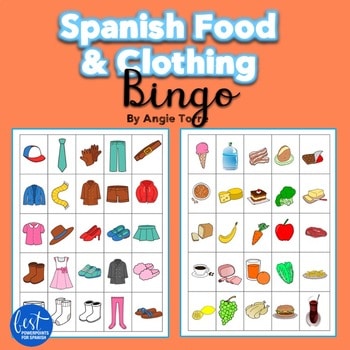
Spanish Food and Clothing Digital and Printable Bingo
Tip #3
Display the Page Number of the Handout
When showing a PowerPoint, DISPLAY THE PAGE NUMBER of the student handout, document, or book where students can find the information on the topic you are discussing. Show the page number on every activity and practice. (Most students will not look it up.) If you don’t want them looking perplexed, getting lost, and then playing with their tech gadgets (or someone’s hair) help them with their organization so they can quickly retrieve the information they need.
Tip #4
Be Proactive. Call Parents.
I have found that talking to the student one-on-one can be effective in changing student behavior but if that doesn’t work, my next step is to call parents.
Honestly, it works only 50% of the time but that’s enough for me. I begin by saying something positive about the student in order to establish a connection with the parent, (and there is always something positive to say about each child) then describing the behavior I would like to see change and enlisting the parent’s help in achieving that change. I am exploring a future blog topic on strategies for speaking with parents.
Tip #5
Use a Sign-Up Sheet.
How do you cover the material and still get all the students to do their presentations, especially on the block schedule? Presentations can eat up days of instructional time.
On the third day, I give students the option to present during lunch or after school. However, since the students who have not yet presented are the least motivated, they are less likely to come in. I create a calendar sign-up sheet and have students sign up for the day they would like to come in. Once they have committed it to paper on a calendar, they are more likely to meet with their partners and present at the agreed-upon time.
And, of course, I nag, nag, nag every day. (I think they call that enabling?) I read the list of students who still need to do their presentations (or take tests). These students need and often benefit from reminders.
Conclusion: The Keys to Student Success
Successful classroom management involves using a variety of strategies to create a positive and supportive environment. By setting clear expectations, building strong relationships, and addressing inappropriate behavior promptly, you can motivate high schoolers and help them achieve their full potential. Remember, the best teachers are those who adapt to their students’ needs, provide positive reinforcement, and maintain a sense of community within the classroom.
If you missed the previous posts on How to Motivate Unmotivated Learners, click on the links below:
How to Motivate Unmotivated Learners, Part One: Positive Peer Pressure, frequent assessments, collaboration, Remind App
How to Motivate Unmotivated Learners, Part Two: Wait time, inclusion, accountability, student photos
How to Motivate Unmotivated Learners, Part Three: How to deal with cell phones; seating chart strategy;
Stay tuned for the next blog on how to write compelling, successful lesson plans.
If you would like to receive more teaching tips in your email, make sure to sign up for my monthly newsletter on the homepage. Scroll to the bottom to subscribe.
Click on the image below to get
your FREE PowerPoint.

 Pinterest
Get More Freebies and Teaching Tips!
Testimonials
Youtube VideosMy Youtube Videos
Pinterest
Get More Freebies and Teaching Tips!
Testimonials
Youtube VideosMy Youtube Videos

This is really beautifully outlined.
Ill ensure that i apply some of the strategies.
Thank you
I’m glad you found it useful. Let me know if you have any questions.
Angi