Preterite in Spanish: 5 Ways to Make It Fun
Drill and Kill—BORING!
When you think of preterite practice, do you think of boring conjugations, drills, and writing exercises? How do you make the preterite tense in Spanish fun? There are many activities that lead students to proficiency while captivating their interest and keeping them actively engaged.
Keep reading for five ways to make the preterite in Spanish fun, along with plenty of free resources and classroom activities you can use with your students. You’ll find ideas to get them listening, speaking, reading, and writing about the past—without another conjugation worksheet!
Here are a few:
Jeopardy, Kahoot, stations, games, competitions, and most importantly, TPRS Stories make the preterite not only fun but easy to assimilate because of the repetition in context. Instead of conjugation drills, tell stories that keep the students engaged and wondering what will happen next.

1. Use Spanish Short Stories for Comprehensible Input
Stories are one of my favorite ways to provide comprehensible input and cement the preterite in students’ minds. The narration is even more effective if the story is comical or ridiculous.
Students get hooked on the plot and become so invested in the story that they almost forget they are hearing or reading in Spanish.
One of my students’ favorite activities is listening to an illustrated story, then rewriting it in pairs. You can use this activity with any story your students understand. Have them change details such as the characters, locations, or objects while keeping the basic structure and writing about what happened in the past. Students get creative, and the resulting stories can be hilarious!
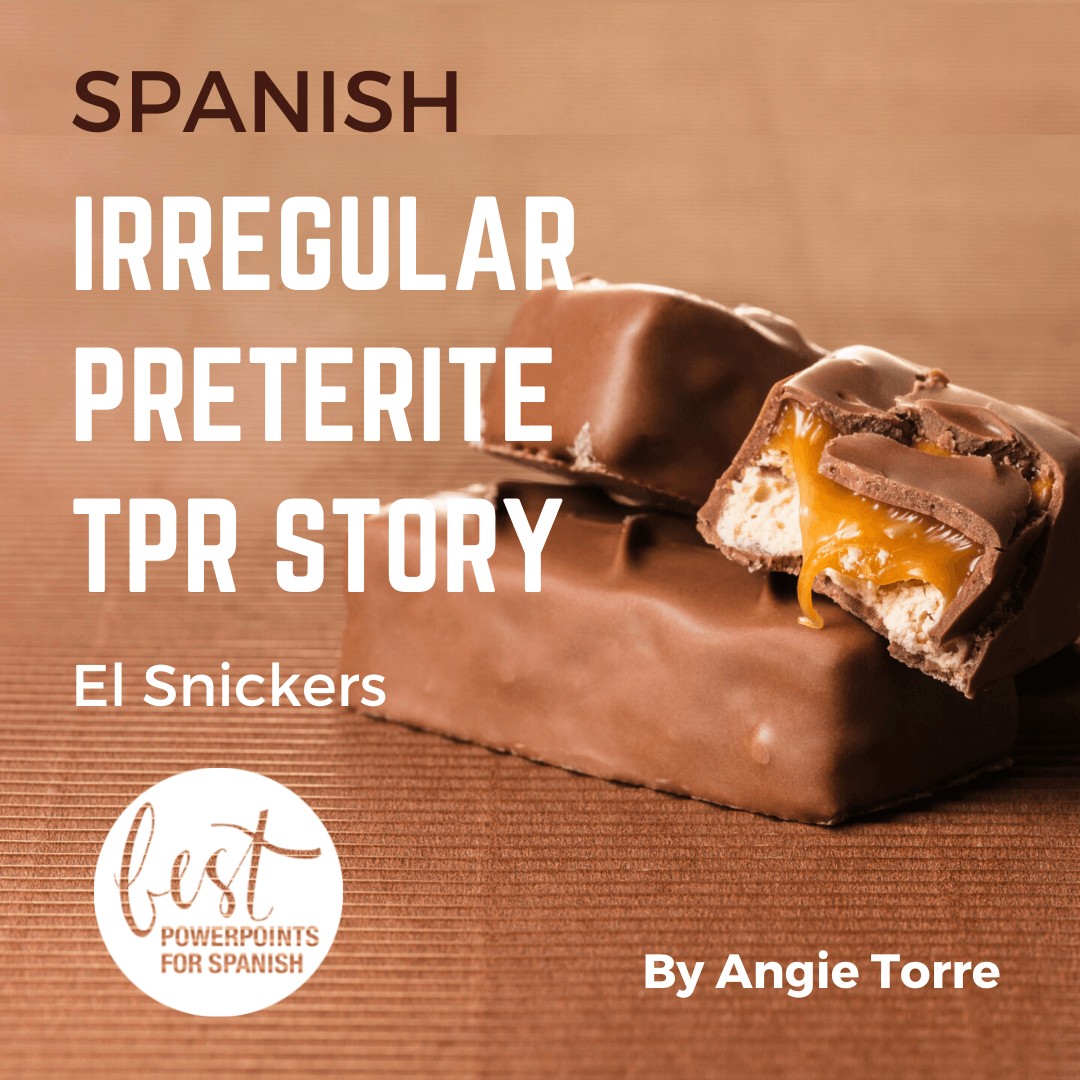
Here’s how I use this activity with my Irregular Preterite TPRS Story PowerPoint, one of my most popular resources with teachers and students. The story repeats irregular preterite forms in context, while the illustrated slides aid comprehension and add humor. A huge Snickers bar is just one of the ridiculous details that keep students interested.
How I Teach the Snickers Story
First I preteach any new vocabulary. Then, I tell the story while projecting the PowerPoint and using TPRS storytelling strategies.
Next, students answer questions about the story, encountering the irregular preterite forms again in context.
STUDENT PRODUCTION ACTIVITY
When students are ready to produce, they rewrite the story in pairs, changing the underlined parts. Finally, I choose a few of their versions to read to the class so everyone can enjoy their creativity—and hear the preterite in context once again. The resulting stories are outrageous and fun to correct.
More Comprehensible Input and TPRS Stories
The Spanish Preterite Tense Short Stories with Reading Comprehension Questions bundle includes six compelling stories that are understandable for students even if they haven’t studied the imperfect yet. The accompanying activities repeat the regular and irregular preterite in context.
My students loved these stories. But don’t take my word for it. Below are a few testimonials:
- “These stories are easy for students to understand, and they were able to infer the meaning of what they didn’t know. “
- “The stories are different enough to keep kids interested while also being able to incorporate the same vocabulary. This kept my students busy for one week while we learned the preterite. Definitely worth the money.”
- “My students had great fun acting out one of these stories. Very happy with my purchase.”
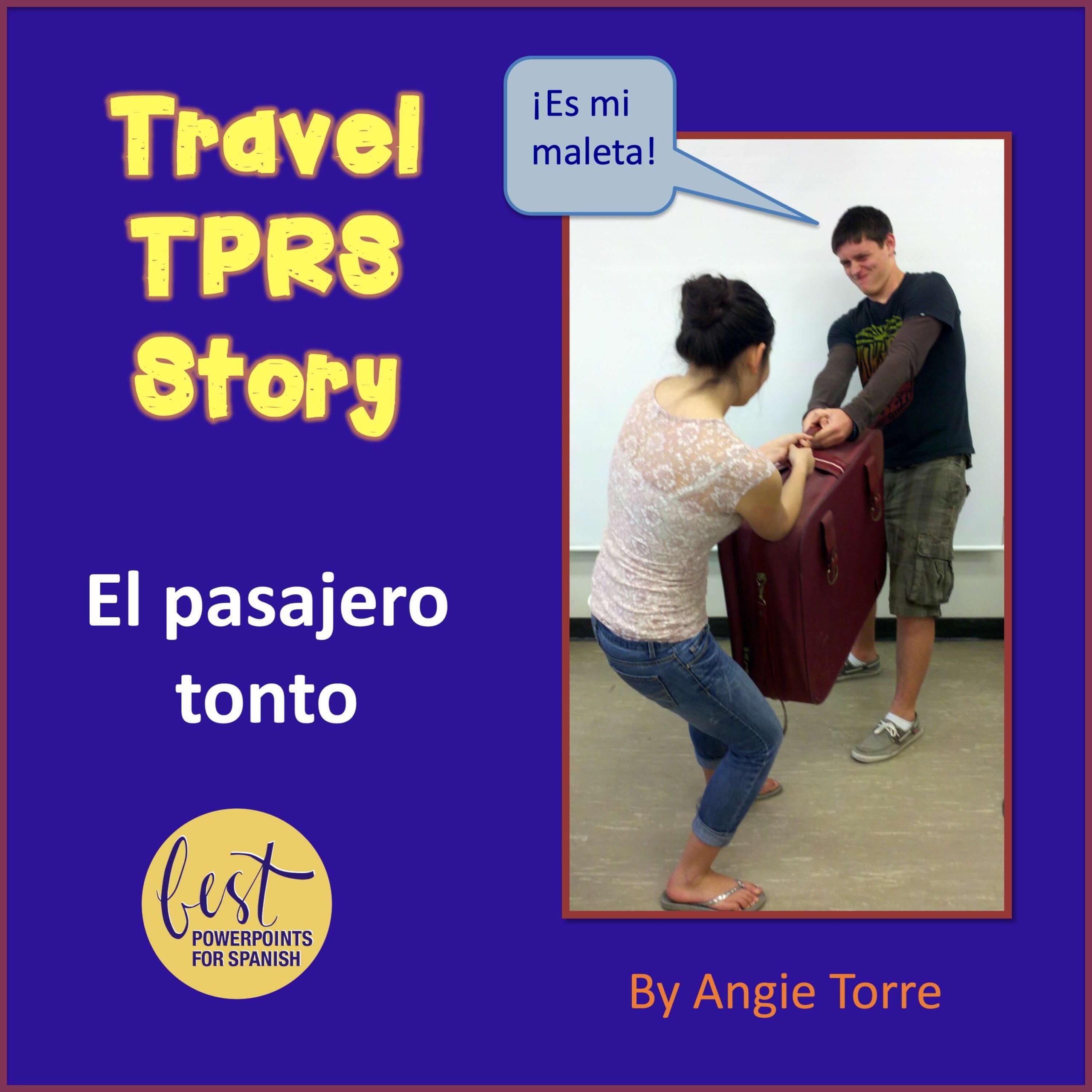
Another student- and teacher-approved story is “El Pasajero Tonto,” which reinforces the Spanish travel vocabulary and the preterite tense. Fifty-two reviews talk about how much fun students had listening to and acting out the story.
Videos for Comprehensible Input
If I put a television frame around my head, I would probably get all eyes on me. When I want to get 100% student participation with no song and dance required on my part, I use videos for comprehensible input.
You can find many videos on YouTube or EdPuzzle. Here is one that repeats the preterite, prepositions of location and “había”: Un ratón en casa. This video and other by Spanish Playground are specifically created for language learners. Therefore, the vocabulary and structures are repeated in context and easy for students to understand.
My advanced students enjoyed authentic videos and Cuentos Infantiles like the ones below.
Because of the varied vocabulary and advanced structures in the children’s stories and fairy tales, I always provided students with a vocab list and pre-taught the words before showing the videos.
While many videos are available online for Spanish learners, it takes time to sift through them and find exactly what you are looking for. I found that most were too advanced and difficult for my students to understand. Others, while comprehensible, lacked a plot. Comprehensible input must be understandable AND compelling. So I set out to create my own videos for targeted CI, that is, using the vocabulary and structures I was teaching. I created these videos to reinforce the preterite and imperfect: Preterite vs. Imperfect videos
The captions in the above videos allow students to read the words as well as hear them—perfect for language learners. I often play the video more than once, the first time with the captions on, the second time without.
2. Use Games to Engage Students
Research links enjoyment of learning with stronger academic achievement. In my experience, students who are having fun become so engaged that they learn without even realizing it. Below are a few games that worked well in my classroom.
Games that require students to write complete sentences about the past. For example, students could play “Find someone who…” Give each student a grid with a different prompt in each square, such as “comer pizza anoche” or “ir al cine el fin de semana pasado.” Students circulate and ask classmates questions: “¿Comiste pizza anoche?” When someone answers yes, they write a complete sentence in that square: “Ana comió pizza anoche.” A name alone doesn’t count, and they must find a different person for each square.
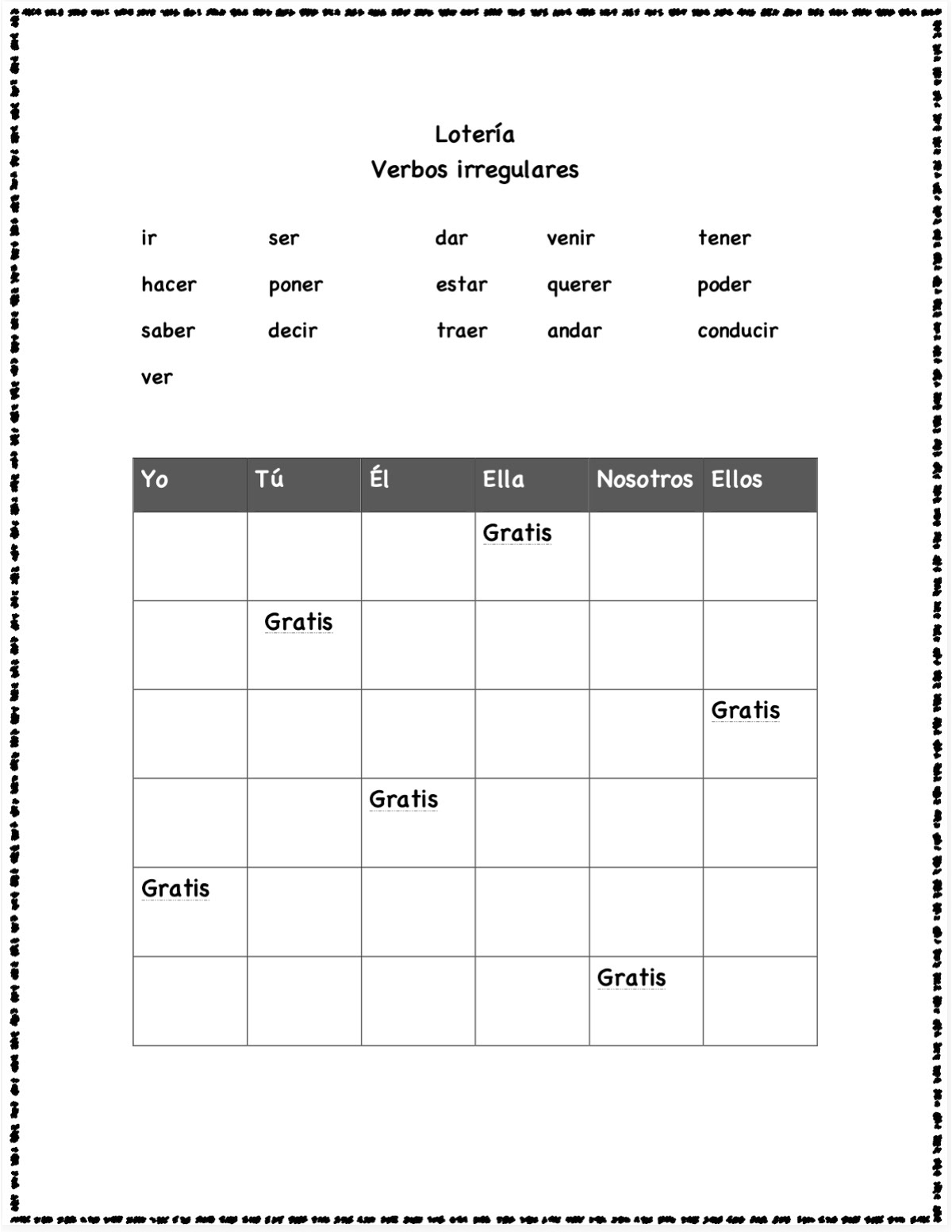
Another game my students love is Bingo. It’s perfect for providing listening practice and language in context. For example: when teaching the irregular preterite, I read complete sentences in the preterite. Students must write the verb in the form they hear. I might say, “Puse mi libro en mi mochila.” Then students would write “Puse” under the “YO” column.
Download the FREE Bingo Game: LOTERÍA
Most of my students enjoyed Jeopardy and participated enthusiastically. This 26-slide game with visuals includes complete sentences to provide comprehensible input: Spanish Preterite Jeopardy Game and Activities
3. Use Digital Activities and Escape Rooms
Whenever I assigned Google Drive or digital activities, many fingers all across the room tap-tapped away. Something about being able to move words around, or type in answers made the activity more fun. All students were riveted to their screens.
I decided to combine Google Drive Activities with other things students love: videos, Google Forms, puzzles, and escape rooms, to create an activity students would be wild about. And—Voilà ! Digital escape rooms.
Turns out I was right. The escape rooms were winners with the kids. Once your students learn the regular and irregular preterite, including the -ir stem-changing verbs, they will have a blast trying to escape from the locked car in this Spanish Digital Escape Room for the Preterite Tense.
Digital Escape Rooms are also great for distance learning. If you’d like to know more about Escape Rooms, click on the following link: 5 Reasons to Use Popular Digital Escape Rooms
DIGITAL MYSTERY PICTURE PUZZLES IN SPANISH
I haven’t figured out why students love digital mystery picture puzzles, but they do. Here are two that I created to help students practice the preterite vs. the imperfect: Spanish Preterite vs. Imperfect Digital Mystery Picture Puzzles
4. Use Paired and Group Activities
Get students talking about the past in Spanish
Once students get enough comprehensible input, get them to talk in pairs and groups. The great thing about paired activities is that students have training wheels, i.e., correct questions already written out to guide them. When answering, they often use the given structure to answer, only needing to respond with the appropriate verb conjugation. And they’re FUN for students!
For example, give students say a sentence and then a question such as “Anoche comí espaghetti. ¿Qué comiste anoche?” and “Hace una semana fui a San Francisco. ¿Adónde fuiste hace una semana?” Partners take turns asking and answering: “Comí pollo con arroz” or “Fui al cine.” The questions provide vocabulary and structure to support their answers while allowing students to share information about their own lives.
Another fun speaking activity is “Continue the Story.” Put students into groups and project images on the screen. Student 1 describes the image, using the preterite, then student 2 continues the story by describing the next image. The classroom walls will echo with student laughter.
READY-MADE PAIRED AND GROUP ACTIVTIES
Don’t want to create your own speaking activities? Below are 17 paired and group activities that include LISTENING, SPEAKING, and WRITING activities, competitions, stations, information-gap tasks, and many visuals. Students ask and answer questions, record their partner’s answers, follow prompts, and complete many other tasks.
The Eight-Stations Activity is super popular; kids beg to play it again. It keeps students speaking Spanish the entire period.
Spanish Preterite Tense Paired and Group Activities
Preterite Tense in Spanish Eight-Stations Activity
5. Use Interactive Notebook Activities
It took me a while to realize my students were sitting passively while I did my song and dance at the front of the room. Nothing is more boring than listening to someone drone on and on.
Interactive notebook activities, flipbooks, and foldables get students actively involved in their learning and use more body parts, thus engaging the brain and enhancing learning. From passivity (Maybe some of the words will enter and stick) to active learning (My hands are involved and sending messages to my synapses, making the necessary connections for learning to take place.)
For example: While watching the Spanish preterite PowerPoint, students completed the activity, changing the verb from the present tense to the preterite. For example: Yo almuerzo / almorzar—almorcé. Then, in a foldable, they conjugated the verbs. Then, they wrote in their flipbooks, completing the sentences with the correct conjugation in the preterite. For example: (Yo / entregar) _____ la tarea. —entregué. / (Ella / decidir) ______ mudarse. —decidió.
The following INB activities, foldables, and flipbooks kept my students actively engaged while learning the preterite and the preterite vs. imperfect.
Spanish Preterite Interactive Notebook Activities
Spanish Preterite vs. Imperfect Foldables
Make Teaching the Spanish Preterite Easier
Do you need PowerPoints for teaching the preterite? Here are two of my most popular Preterite PowerPoints:
Preterite PowerPoint, TPR Story and Interactive Notebook Activities
Spanish Irregular Preterite PowerPoint
Spanish Preterite PowerPoints and Curriculum give you everything you need to teach the preterite and enable your students to speak proficiently about what happened in the past.
Don’t have time to write lesson plans? These Spanish Preterite Lesson Plans and Curriculum do everything for you so all you have to do is teach, correct, and go home. They include tons of stories, games, and engaging activities.
HOW TO MAKE THE PRETERITE FUN FOR TEACHERS
Well, maybe not FUN, but definitely easier! Google Forms quizzes do everything for you. They auto-correct and are editable, so you don’t have to spend time creating and correcting your own tests and activities. Below are a few ready-made assessments you can use:
The Preterite Tense in Spanish Google Forms Activities
Spanish Preterite Tense Dar and Ver Google Forms Quiz
Don’t drill and kill the preterite tense in Spanish. Tell stories. Play games. Make the preterite fun and soon your students will be talking fluidly about what they did and what happened in the past.
Which of these ideas will you try first? Choose one to use with your students this week, and take advantage of the free resources above to get started. Have a favorite activity for practicing the preterite in Spanish? Share it in the comments—I’d love to hear what works in your classroom!
 Pinterest
Get More Freebies and Teaching Tips!
Testimonials
Youtube VideosMy Youtube Videos